Find Scooter & Motorcycle Hire in Turkey
Enter your city, island or destination below to search available scooters and motorcycles.
Enter your city, island or destination below to search available scooters and motorcycles.
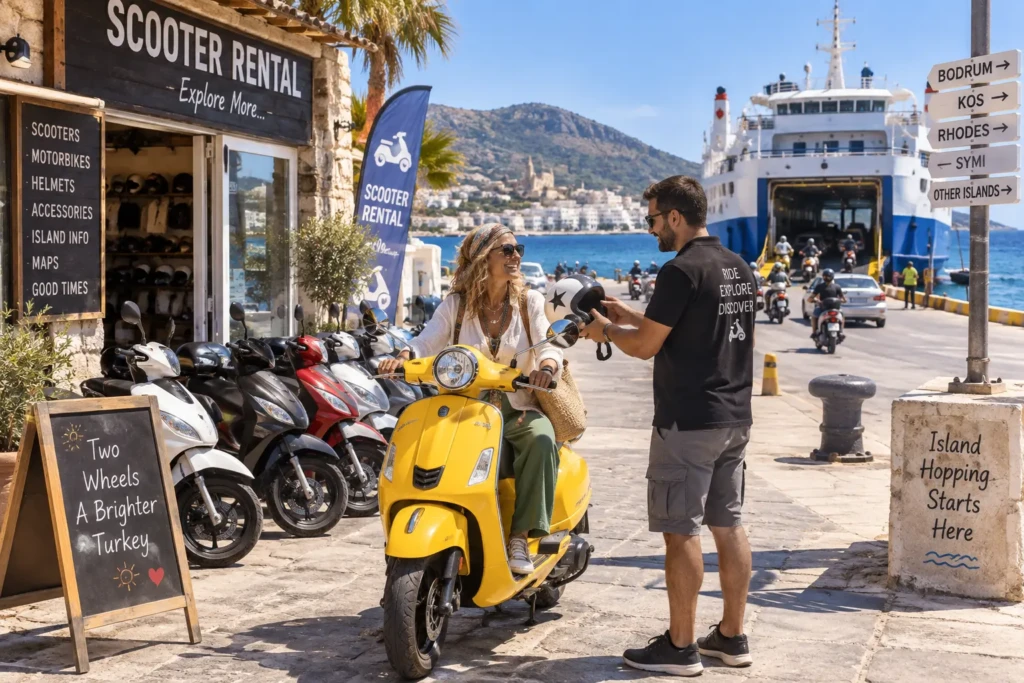
Explore Turkey on Two Wheels
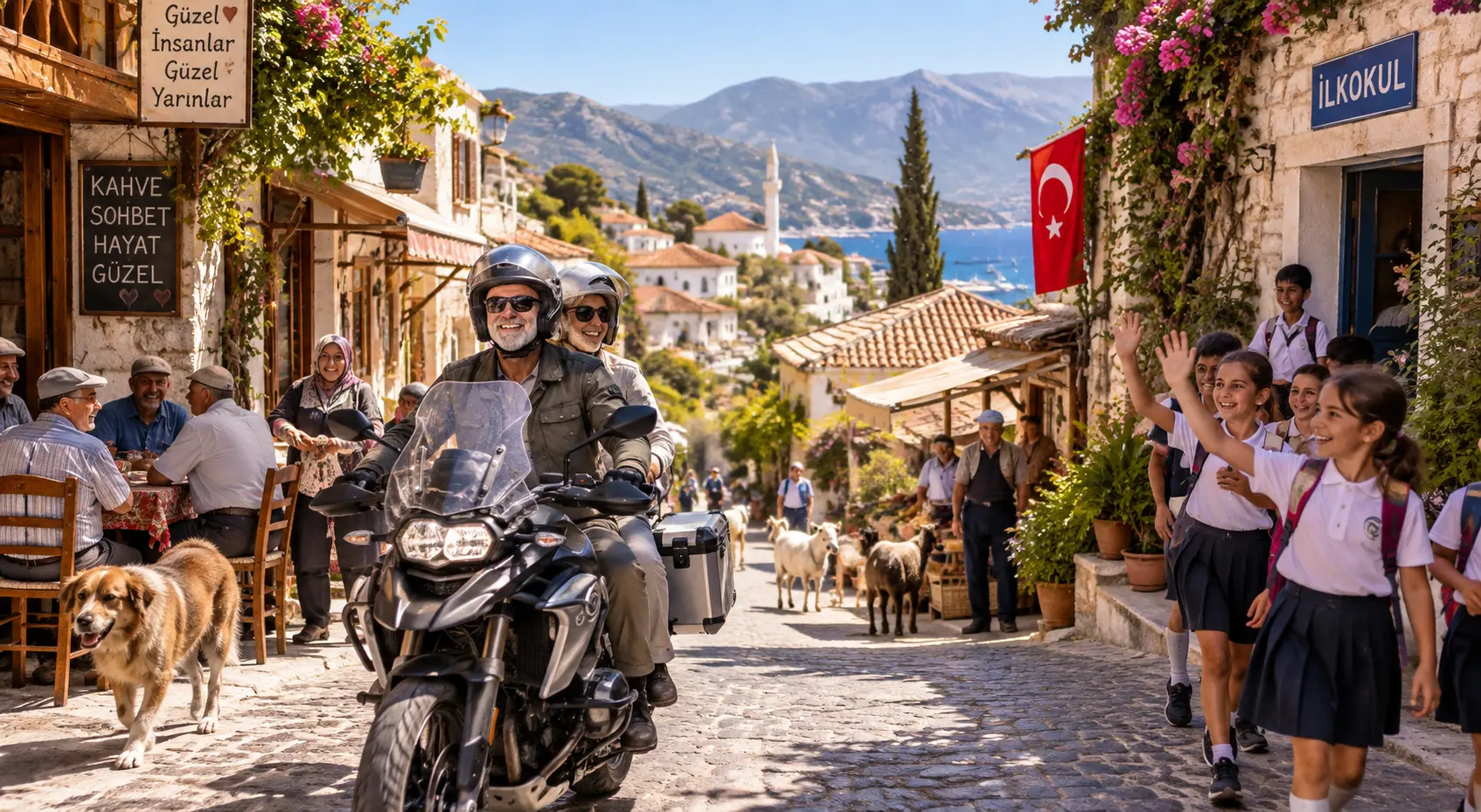
From Turkey’s turquoise Mediterranean coast to pine-covered hills, ancient ruins and traditional villages, travelling by scooter or motorcycle gives you the freedom to discover much more at your own pace.
Ride beyond Fethiye towards Ölüdeniz and the abandoned village of Kayaköy, or explore the Bodrum Peninsula, where winding roads connect beautiful bays, fishing villages and lively seaside towns.
Further east, Antalya combines long stretches of Mediterranean coastline with ancient sites, mountain scenery and roads leading away from the busy resorts towards a very different side of Turkey

Coastlines Made for Exploring
Follow Turkey’s turquoise coast through beautiful bays, beaches and seaside towns.

Mountains, Villages & Ancient Roads
Ride beyond the resorts through mountain scenery, historic sites and traditional villages.

Freedom to Explore Further
Discover hidden corners of Turkey that are easier to reach on two wheels.
Explore Turkey
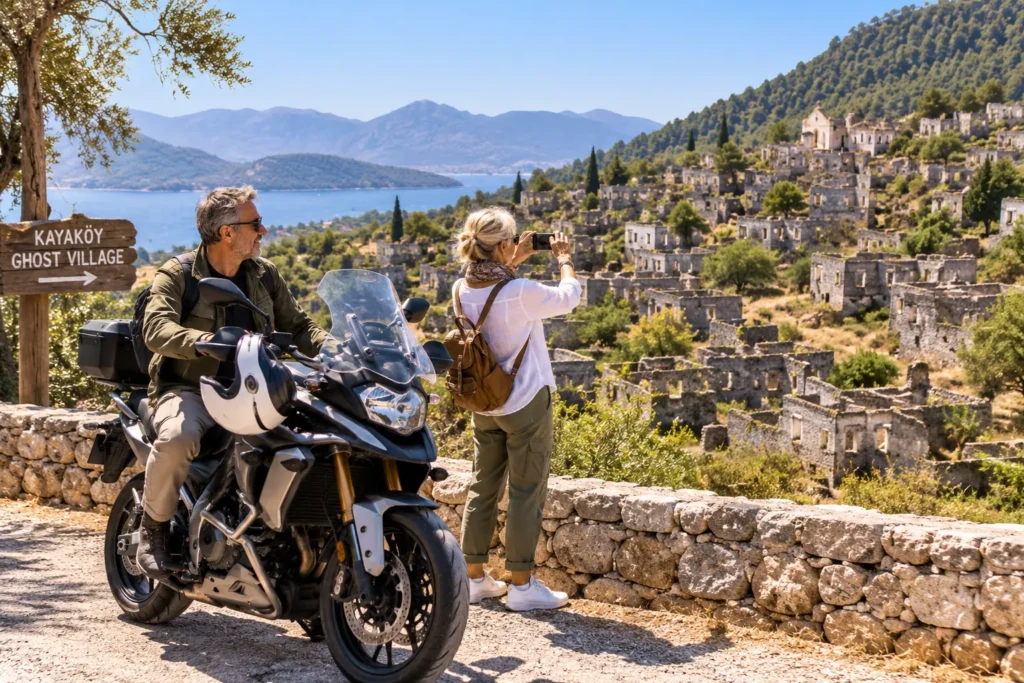
Fethiye
Explore ancient ruins, mountain roads and the beautiful turquoise coastline around Fethiye.
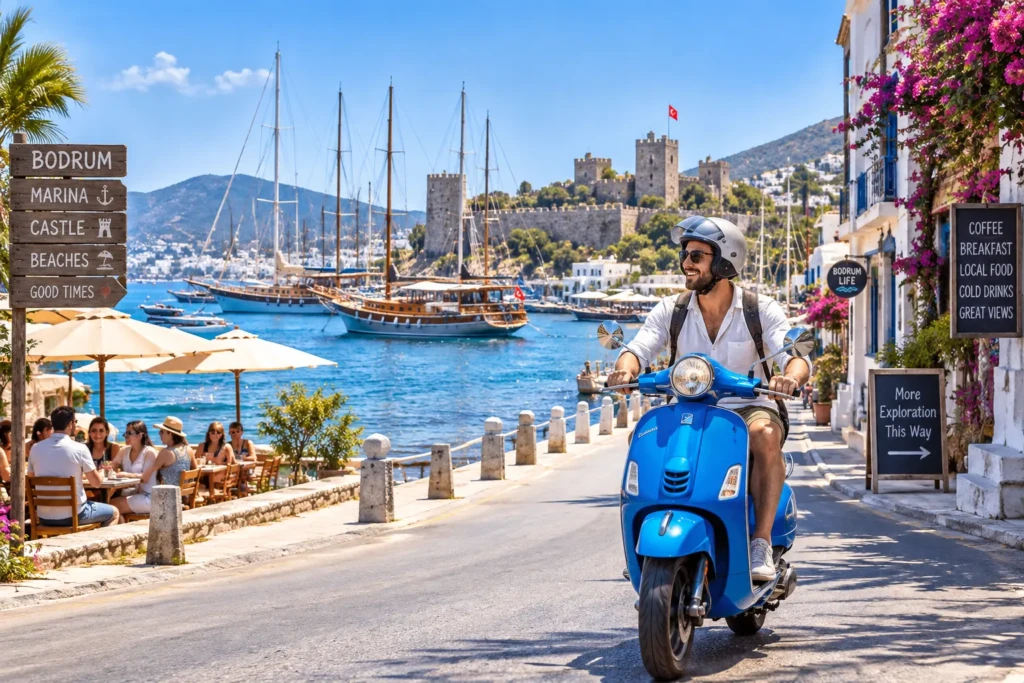
Bodrum
Ride around Bodrum’s peninsula through seaside villages, beautiful bays and lively coastal towns.
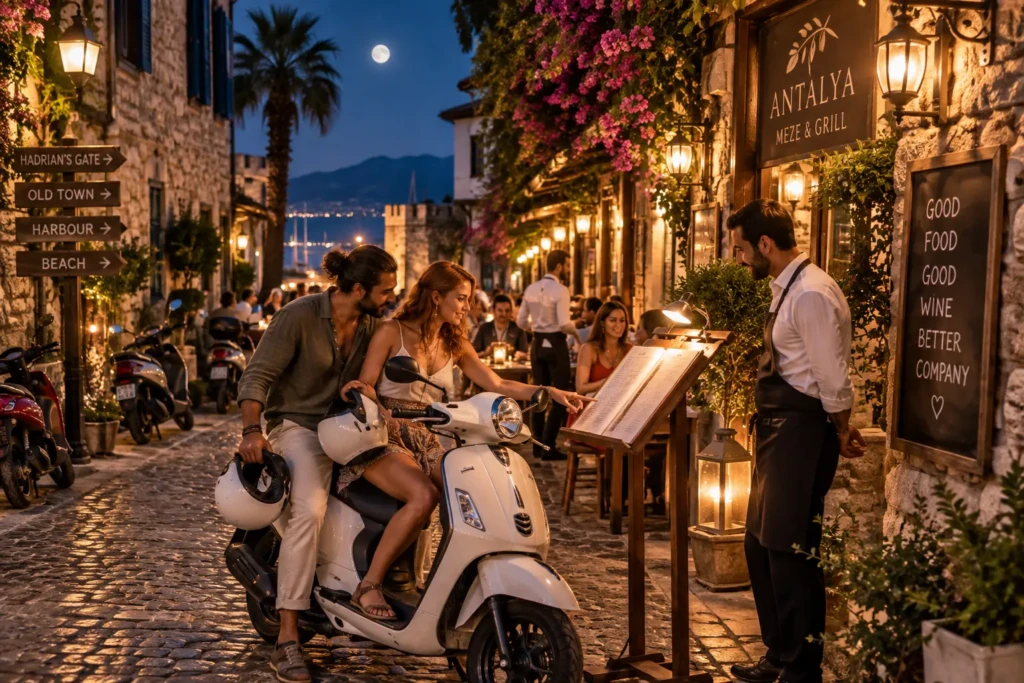
Antalya
Discover Antalya’s historic streets, Mediterranean coastline and spectacular mountain scenery.
More places to ride in Turkey
Considerations Before You Ride in Turkey
You need a valid driving licence that covers the type and engine size of scooter or motorcycle you intend to hire. For UK visitors, government travel advice specifically states that you need at least Category A1 motorcycle entitlement to hire and ride a moped in Turkey.
Category A1 on a UK licence covers light motorcycles of up to 125cc and 11kW. More powerful motorcycles require the appropriate higher motorcycle entitlement — typically A2 or A, depending on the vehicle’s power and your licence.
This means you should not assume that holding a standard Category B car licence is sufficient to hire a scooter in Turkey. Check the motorcycle categories shown on your driving licence against the specification of the vehicle before booking.
UK visitors also need the appropriate documentation for using their licence in Turkey. Current UK Government guidance says you need either a 1968 International Driving Permit (IDP) alongside your UK licence, or a UK driving licence notarised in Turkish. The older 1949 IDP is no longer accepted in Turkey.
Rental companies can impose additional conditions, including minimum ages, how long you must have held your motorcycle licence and restrictions on particular vehicles. Check the requirements for the scooter or motorcycle you choose before confirming your hire.
Useful official information:
UK Government – Turkey Travel Advice: Road Travel and Moped Hire
UK Government – Motorcycle Licence Categories
UK Government – International Driving Permits
Sometimes, but you must check both the ferry service and your rental agreement before travelling. Some Turkish ferry routes accept motorcycles as vehicles, so taking a scooter aboard is physically possible on services equipped to carry vehicles. Ferry operators can have their own booking, vehicle and boarding requirements.
For Turkish islands such as Bozcaada, motorcycles are commonly used on the island. The official Bozcaada district authority specifically lists motorcycle hire as a way of getting around, although it encourages visitors to avoid bringing vehicles onto the island unless necessary during busy periods.
However, permission from the rental company is separate from the ferry operator’s rules. A rental agreement may restrict taking the scooter on ferries, onto particular islands or outside the area in which it was hired. Insurance cover may also be affected. Always check the rental terms or obtain permission before boarding.
Be particularly careful with ferries from Turkey to Greek islands such as Kos, Rhodes or Samos. This involves taking a rental vehicle across an international border, not simply island hopping within Turkey. Passenger ferry services do not necessarily accept motorcycles, and taking a Turkish rental vehicle abroad can involve additional permission, insurance and customs requirements. For example, İDO’s current Aegean-island rules specifically provide for bicycles on several routes but do not provide equivalent general permission for passengers to take motorcycles.
So, unless your rental company expressly permits international travel and the ferry operator confirms that your particular sailing carries motorcycles, don’t assume you can take a hired scooter from Turkey to a Greek island.
Useful information:
Bozcaada District Government – Getting Around the Island
İDO – Aegean Islands Travel Rules
When riding a scooter or motorcycle in Turkey, both the rider and any passenger must wear a properly fastened protective helmet. Turkish regulations specify helmets meeting the UNECE ECE R22 standard.
Following changes to Turkey’s road traffic regulations, motorcycle riders and passengers must also wear protective gloves. Riders are additionally required to use protective eyewear, although separate goggles are not necessary where suitable eye protection is incorporated into the helmet.
There is another easily overlooked requirement if you plan to ride after dark. Turkish traffic regulations require motorcycle riders and passengers to wear reflective clothing, such as a reflective vest, when travelling at night so that they remain visible to other road users.
For visitors hiring a scooter, don’t assume that every item of required equipment will automatically be included. Check exactly what the rental company supplies before you ride, particularly if you will be carrying a passenger or riding at night. At minimum, make sure you have suitable helmets for everyone travelling and confirm the availability of gloves and any other required equipment.
It’s also sensible to go further than the legal minimum. Proper footwear, long trousers and an abrasion-resistant motorcycle jacket can provide considerably more protection than typical summer holiday clothing.
The UK Government specifically warns visitors hiring mopeds in Turkey that drivers and passengers must wear helmets and says failure to do so may invalidate insurance; it also warns that police can issue a fine and take your licence.
Useful official information:
Turkish Ministry of Transport – Highway Traffic Regulations
UK Government – Turkey Travel Advice
Yes. Turkey has legal minimum ages for motorcycle licence categories, but the minimum age for hiring a scooter is ultimately set by the individual rental company and may be higher.
Under current Turkish rules, the minimum ages for obtaining the relevant motorcycle licence categories are 16 for M and A1, 18 for A2, and 20 for Category A. Category A normally also requires at least two years’ experience with an A2 licence, although that experience requirement does not apply once the rider is 24.
For visitors, however, being old enough under Turkish licensing law does not automatically mean that a rental company will hire you a scooter. Rental companies can impose their own minimum age and driving-experience requirements, and these can vary according to the engine size or power of the motorcycle.
UK visitors should also remember that the licence itself must cover the vehicle being hired. Current UK Government travel advice states that anyone hiring a moped in Turkey needs a valid driving licence with at least Category A1 (light motorcycle) entitlement.
So before booking, check three things: your age, the motorcycle entitlement on your licence, and the rental company’s minimum-age and licence-holding requirements for that particular scooter or motorcycle.
Useful official information:
Turkish Ministry of Education – Driving Licence Requirements
UK Government – Turkey Travel Advice
If you’re travelling with a UK driving licence, yes — unless your UK licence has been notarised in Turkish. Current UK Government travel advice states that you need either a 1968 International Driving Permit (IDP) or a UK driving licence notarised in Turkish to drive in Turkey.
For most UK holidaymakers planning to hire a scooter or motorcycle, obtaining the 1968 IDP before travelling is likely to be the simpler option. The IDP must be carried alongside your original UK driving licence; it does not replace your licence or give you additional motorcycle entitlement. Your UK licence must still cover the class of scooter or motorcycle you intend to ride.
Be careful if you already have an IDP from previous travel. Turkey requires the 1968 version — the UK Government specifically states that the 1949 IDP is no longer accepted in Turkey.
A 1968 IDP is normally valid for three years, or until your UK driving licence expires, whichever comes first. UK residents can currently obtain one in person from participating shops offering the PayPoint IDP service.
If your driving licence was issued outside the UK, requirements can differ, so check with the relevant Turkish authorities or your country’s embassy before travelling. Your rental company may also ask to see your IDP and original licence when collecting the scooter.
Useful official information:
UK Government – Turkey Travel Advice
UK Government – International Driving Permits
Yes. Turkey drives on the right-hand side of the road, so UK riders should take particular care at junctions, roundabouts and when pulling away after stopping. Road conditions on major routes are generally good, although the UK Government advises extra caution at night and notes that surfaces can be poorer in remote areas.
Speed limits depend on both the road and the type of motorcycle. Turkey’s General Directorate of Highways currently lists limits for standard L3 motorcycles of 50 km/h in built-up areas, 80 km/h on two-way intercity roads, 90 km/h on divided roads and 100 km/h on motorways. Lower limits apply to mopeds and some other motorcycle classifications, and posted signs or local restrictions take precedence.
A small moped may also be subject to different road-access rules. Turkey classifies L1, L2 and L6 motorised bicycles with lower maximum speeds and states that these vehicles cannot use motorways. This is worth checking if you’re hiring a low-powered machine rather than a conventional scooter or motorcycle.
Do not drink and ride. Turkish law prohibits driving under the influence of alcohol or drugs, and police can impose fines and suspend a driving licence for alcohol offences. The UK Government specifically advises visitors to Turkey not to drink and drive.
Motorcyclists must also obey normal lane rules. Turkey’s Traffic Police states that drivers should not continuously occupy the far-left lane unless appropriate and that emergency lanes and hard shoulders must not be used for ordinary riding.
Finally, take particular care on unfamiliar rural and coastal roads. The routes around places such as Fethiye, Bodrum and Antalya can take you from busy resort traffic onto mountain and village roads surprisingly quickly. Ride to the conditions rather than treating the legal speed limit as a target.
Useful official information:
Turkish General Directorate of Highways – Official Speed Limits
UK Government – Turkey Travel Advice
Some insurance should be provided with a legally operated rental scooter in Turkey, but you should not assume that this means you have comprehensive cover. Turkey has compulsory motor third-party liability insurance, and Turkey’s insurance regulator publishes specific compulsory cover limits for motorcycles.
For UK travellers, the UK Government gives particularly useful guidance on vehicle hire in Turkey: it warns that insurance sold with hired mopeds and similar vehicles usually provides only third-party cover. This can leave you responsible for damage to the scooter itself following an accident.
Before confirming your hire, check exactly what the insurance includes. In particular, look for the excess or deductible, whether theft and accidental damage are covered, and whether there are exclusions for particular roads, locations, ferry travel, additional riders or other circumstances.
You should also check your own travel insurance separately. Standard travel insurance does not necessarily cover riding a hired scooter or motorcycle; UK Government guidance specifically warns that moped hire is often excluded. Make sure your policy covers the engine size you intend to ride and that you hold the correct motorcycle licence.
Wearing the required safety equipment is important for insurance too. UK Government Turkey advice warns that riding without a helmet may invalidate your insurance, as well as resulting in enforcement action.
So, even when insurance is included in the hire price, check the level of cover rather than assuming you’re fully protected. If optional additional cover is offered, compare it with the standard policy and understand what you would have to pay yourself following theft, damage or an accident.
Useful official information:
UK Government – Turkey Travel Advice
UK Government – Foreign Travel Insurance Guidance
Turkey’s Insurance Regulator – Compulsory Traffic Insurance Limits
There can be. The advertised hire price may not represent every cost you could incur, so check exactly what is included before confirming your scooter or motorcycle.
Depending on the rental company and your booking, additional costs could include a refundable security deposit, optional insurance upgrades or excess reduction, additional riders, extra helmets or equipment, delivery or collection charges, one-way hire, additional mileage, fuel or refuelling charges, and ferry costs if you plan to take the scooter on an approved ferry route.
You could also become liable for charges arising during the rental, such as traffic or parking fines, tolls, lost keys, late return, damage to the scooter or an insurance excess. The precise amount and circumstances should be set out in the rental terms rather than assumed.
Turkey’s Ministry of Trade states that information about fees and expenses chargeable to consumers must be provided as part of the contractual information. For online contracts, consumers must also be informed before purchase of the total price including taxes and any applicable additional delivery or similar costs.
It’s therefore worth checking the final price and rental conditions carefully before paying, particularly the deposit, insurance excess, fuel policy, mileage allowance and what happens if the scooter is damaged or returned late. If you’re unsure about a charge, ask the rental company to confirm it before accepting the vehicle.
One other useful point for advance bookings: Turkish consumer guidance lists vehicle rental for a specified date or period among the exceptions to the normal 14-day withdrawal right for distance contracts. In other words, don’t assume you can cancel an online rental within 14 days without charge simply because it was booked online.
Useful official information:
Turkish Ministry of Trade – Consumer Contract Guidance
Turkish Ministry of Trade – Distance Contracts Guidance
Ready to ride in Turkey?
Search available scooters and motorcycles for your trip.